
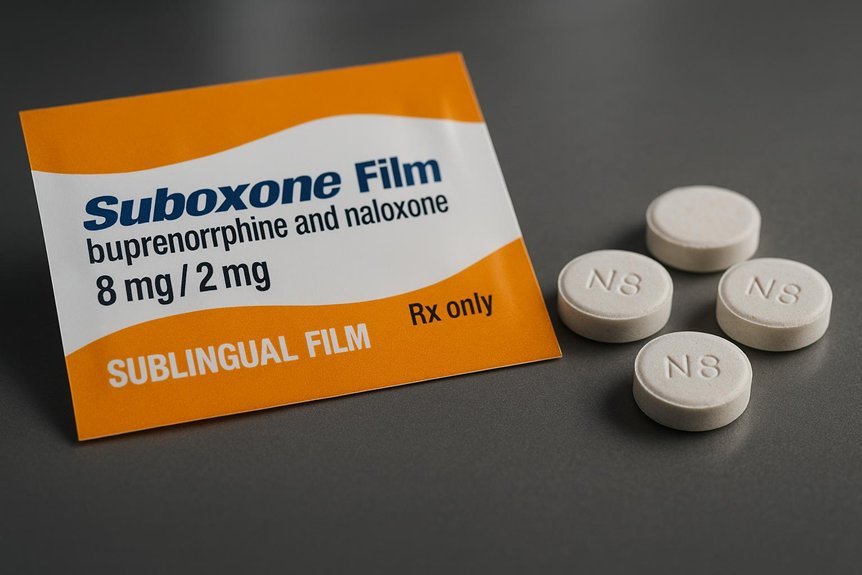
Suboxone Film vs. Tablets: Which Is Better?
When deciding between Suboxone films and tablets, you’ll want to evaluate factors like absorption rate, ease of use, and personal preferences. Films dissolve quickly under the tongue, offering discreet and portable convenience, while tablets provide precise dosage control but may take longer to absorb. Both forms have distinct benefits and side effects, with films generally reducing misuse risk. So, which form truly aligns with your needs and lifestyle? Let’s explore further.
Comparing Suboxone Film and Tablets: Key Differences
When comparing Suboxone film and tablets, you'll find a few key differences that impact their use and effectiveness.
The film offers advantages like quicker absorption and easier administration, leading to preferences for film convenience. Its effectiveness is often noted in reducing cravings efficiently.
In contrast, tablets can pose drawbacks, such as slower absorption, and potential side effects like nausea. However, tablet accessibility remains a benefit due to wider availability.
Compliance can vary, with some finding tablets easier to manage daily.
Understanding Suboxone: A Quick Overview
You’ll find Suboxone combines buprenorphine and naloxone to manage opioid dependence effectively.
It’s designed to reduce withdrawal symptoms and cravings, helping you maintain recovery.
Administered either as a film or tablet, it’s absorbed sublingually, ensuring efficient delivery into your system.
Components of Suboxone
Suboxone, a vital player in opioid addiction treatment, combines two active ingredients: buprenorphine and naloxone.
Buprenorphine is a partial opioid agonist, which means it binds to opioid receptors, reducing cravings and withdrawal symptoms. Naloxone, an opioid antagonist, blocks opioid effects, discouraging misuse.
These components work together under established treatment protocols to aid recovery effectively. When you take Suboxone, buprenorphine primarily manages your symptoms, while naloxone acts as a safeguard against potential abuse.
Understanding these active ingredients is essential for comprehending how Suboxone fits into extensive treatment plans, providing a balanced approach to managing opioid dependence.
Purpose and Benefits
Building on the understanding of Suboxone's components, here is its purpose and benefits. Suboxone is designed to aid in opioid addiction treatment, offering several advantages.
- Therapeutic effectiveness: Combines buprenorphine and naloxone for effective withdrawal management.
- Patient adherence: Easy administration improves adherence.
- Treatment outcomes: Enhances recovery rates by mitigating cravings.
- Psychological impact: Reduces anxiety associated with withdrawal.
- Lifestyle integration: Convenient dosing supports daily life activities.
A thorough benefit analysis reveals cost effectiveness and long-term benefits, making Suboxone a viable option for many.
It's essential for achieving sustained recovery and improving overall quality of life.
Administration and Absorption
When considering Suboxone's administration and absorption, it’s crucial to understand its two primary forms: film and tablets. Each has distinct administration methods affecting absorption rates.
The film dissolves sublingually, offering a potentially faster onset due to its thin structure, which may enhance absorption rates. Tablets also dissolve sublingually but can take longer, possibly resulting in varied absorption.
You should verify proper placement under the tongue for both forms to maximize effectiveness. Clinical studies suggest films may provide more consistent absorption, yet individual responses vary.
Choose the form that aligns with your treatment needs and consult your healthcare provider for guidance.
Liberation Way's helpline is free, confidential, and available 24/7. A treatment specialist can help you understand your options.
Call (866) 275-3142Suboxone Films: How They Work
Although often overlooked, understanding how Suboxone films work is crucial for effective treatment. They dissolve quickly under your tongue, delivering buprenorphine and naloxone efficiently. This method enhances absorption, offering significant suboxone film benefits like rapid onset and ease of use.
However, suboxone film limitations include potential misuse if not used correctly.
Consider these key points:
- Rapid absorption: Guarantees quick relief.
- Ease of use: Simple administration under the tongue.
- Reduced misuse: Lower risk compared to other forms.
- Size and taste: More discreet and palatable.
- Storage: Requires careful handling to maintain effectiveness.
Understanding these aspects aids in maximizing treatment success.
Suboxone Tablets: What Sets Them Apart?
When considering Suboxone tablets, you’ll find distinct differences in dosage accuracy and administration compared to films.
Tablets may offer a more neutral taste and firmer texture, which some patients prefer.
Additionally, their solid form enhances storage convenience and portability, making them a practical choice for many.
Dosage and Administration Method
Even though both Suboxone film and tablets are designed to deliver buprenorphine and naloxone, the tablets offer distinct advantages regarding dosage and administration.
Tablet administration allows for precise suboxone dosage and easier dosage adjustments, enhancing therapeutic effectiveness. Unlike film absorption, tablets can be split to aid suboxone titration, promoting better patient compliance and medication adherence.
Consider these benefits:
- Precise suboxone dosage control for tailored treatment.
- Flexible dosing frequency to match individual needs.
- Easier dosage adjustments to optimize therapeutic outcomes.
- Improved patient compliance through customizable administration methods.
- Enhanced medication adherence thanks to straightforward tablet use.
Taste and Texture Differences
Many patients notice distinct taste and texture differences between Suboxone film and tablets, which can impact their treatment experience.
Tablets often have a chalky texture that some find unpleasant, influencing texture preferences. The flavor profiles differ too; tablets may have a more medicinal taste, affecting the overall oral experience.
Sensory feedback is essential in adherence, as an unappealing taste or texture might discourage consistent use. While some patients adapt to the tablets, others prefer the films due to smoother dissolution and milder flavor.
Understanding these differences helps you make an informed choice based on personal preferences and treatment goals.
Storage and Portability Features
Suboxone tablets stand out for their storage and portability features, offering distinct advantages for patients on the go. Tablets provide practical storage solutions and portability options, making them a preferred choice for many. They’re less susceptible to environmental factors compared to films, ensuring stability.
Consider these benefits:
- Compact size: Easy to carry discreetly.
- Stable in various conditions: Better resistance to humidity.
- Durable packaging: Reduces risk of damage.
- Long shelf life: Extends usability.
- Convenient dosing: Simplifies daily routines.
Choosing tablets enhances your ability to manage treatment effectively while maintaining an active lifestyle.
Does Formulation Affect How Well It Works?
While exploring the effectiveness of Suboxone, it’s essential to evaluate whether the formulation—film or tablet—impacts its efficacy.
The formulation impact primarily revolves around absorption rates. Studies suggest that Suboxone films may offer faster absorption compared to tablets, potentially leading to quicker onset of action.
Suboxone films may absorb faster than tablets, potentially offering a quicker onset of action.
This difference in absorption rates can influence how effectively the medication manages withdrawal symptoms and cravings.
However, both forms contain the same active ingredients, buprenorphine and naloxone, ensuring similar therapeutic outcomes.
Ultimately, individual response can vary, so consulting with a healthcare provider will help determine which formulation best suits your needs.
Ease of Use: Films vs. Tablets
When considering ease of use, films and tablets each have distinct advantages. Film convenience is evident as they dissolve quickly under your tongue, making them simple to administer without water.
Tablets, known for their reliability, offer a straightforward approach with a familiar, pill-like form.
Here are key points:
- Film convenience: Quick dissolve time.
- Tablet reliability: Familiarity and consistency.
- Portability: Films are lightweight and discreet.
- Administration: Films don't require water; tablets might.
- Precision: Both forms offer accurate dosing but differ in handling.
Each option provides unique benefits, helping you choose what suits your lifestyle best.
Patient Preferences: The Importance of Choice
Choosing between Suboxone films and tablets often depends on personal preferences, underscoring the significance of choice in treatment.
Exercising patient autonomy allows you to make informed choices based on treatment preferences and personal experiences.
Enabling patients to make informed choices enhances their treatment through personal preferences and experiences.
Consider how lifestyle impact and emotional factors play a role in your decision-making process. Accessibility issues may influence your choice, and peer support can offer valuable insights.
Healthcare guidance is essential in steering through these options, helping you weigh the pros and cons effectively.
Ultimately, choosing a form that aligns with your needs supports a more personalized and successful treatment experience.
How to Use Suboxone Film
To guarantee Suboxone Film is effective, place it under your tongue and let it dissolve completely without chewing or swallowing.
This technique maximizes absorption, allowing the medication to work efficiently.
Consistent application is essential for maintaining its effectiveness in managing opioid dependence.
Proper Application Technique
Applying Suboxone Film correctly secures you receive the full benefits of the medication. To verify a proper application, follow these steps to overcome common application challenges:
- Wash your hands before handling the film to prevent contamination.
- Place the film under your tongue, confirming it doesn’t overlap.
- Avoid eating or drinking until the film completely dissolves.
- Don’t talk while the film is dissolving to guarantee proper absorption.
- Store the film at room temperature, away from moisture and direct sunlight.
Absorption and Effectiveness
While using Suboxone Film, understanding its absorption process is essential for maximizing its effectiveness.
The film's absorption rates often surpass tablets, leading to higher bioavailability. This formulation impact results in improved pharmacokinetic profiles and enhanced therapeutic outcomes.
Patient experiences highlight increased user satisfaction due to the film's efficient administration techniques.
In effectiveness comparison, films generally offer quicker relief and sustained long-term effects.
Bioavailability differences between films and tablets can greatly influence your treatment results.
Proper Use of Suboxone Tablets
Understanding the proper use of Suboxone tablets is essential for effective treatment and safety. You’ll find that while tablets offer certain advantages, like ease of storage, there are challenges to weigh, such as ensuring tablet adherence. Here’s how to optimize their use:
- Patient education: Learn about the differences in film preference and tablet use.
- Dosage accuracy: Follow your prescribed amount precisely.
- Treatment consistency: Maintain a regular schedule for taking your tablets.
- Side effect management: Be aware of potential side effects and report concerns.
- Suboxone advantages: Understand the benefits and challenges to maximize your treatment success.
Comparing Taste and Texture: Films vs. Tablets
When comparing the taste and texture of Suboxone films and tablets, you might notice distinct differences that can influence your treatment experience.
Films often dissolve quickly, offering a smoother texture and more consistent flavor profiles. Many users prefer this sensory experience due to its subtle, less medicinal taste.
In contrast, tablets can have a chalkier texture and stronger taste, which some find off-putting. User feedback suggests that taste preferences vary, but films generally receive more favorable reviews in product comparisons.
Texture variations play a significant role in choosing between the two, impacting overall satisfaction and adherence to treatment.
Portability: Which Is More Convenient?
When considering portability, you'll find Suboxone film offers greater convenience due to its lightweight and compact packaging, making it easier to transport discreetly.
Unlike tablets, films don't require a pill bottle, reducing storage space and enhancing concealment. This can be particularly beneficial for maintaining privacy and ease of use in various settings.
Ease of Transportation
Transporting Suboxone can be a concern for many users, and evaluating the portability of films versus tablets is essential. Films often offer greater transportation convenience due to their slim packaging, making them travel-ready. Tablets, while also convenient, may require more strong packaging to prevent damage.
Consider the following:
- Discreetness: Films are less noticeable than tablets.
- Weight: Films are lighter and easier to carry in bulk.
- Size: Films take up minimal space in bags or pockets.
- Durability: Films are less prone to breakage compared to tablets.
- Travel Readiness: Films are often more convenient for quick, on-the-go use.
Storage Requirements
While considering Suboxone storage, it’s important to weigh the options between films and tablets. Suboxone films are more temperature-sensitive and require specific storage containers to protect against humidity effects. Conversely, tablets offer a longer shelf life and are less affected by environmental factors. Packaging considerations are significant; films need individual blister packs, whereas tablets are typically stored in bottles. Expiration dates may vary, so always check them before use. When traveling, take precautions to prevent exposure to extreme temperatures. Here's a quick comparison:
| Aspect | Films | Tablets |
|---|---|---|
| Temperature Sensitivity | High | Moderate |
| Humidity Effects | Significant | Minimal |
| Shelf Life | Shorter | Longer |
Discreet Usage Options
Deciding between Suboxone films and tablets often boils down to portability and discreetness. Films offer discreet consumption, easily fitting into your pocket for quick access during social settings.
They're less noticeable in public usage, addressing privacy concerns effectively. Tablets can be more conspicuous, but personal preference plays a role in your decision.
Consider these convenience factors:
- Discreet consumption in public
- Ease of carrying in pockets or wallets
- Quick administration in social settings
- User comfort based on lifestyle compatibility
- Privacy concerns in various environments
Ultimately, your choice hinges on which format aligns best with your daily routines and comfort.
Cost Comparison: Films vs. Tablets
When evaluating the cost of Suboxone, it’s essential to take into account the differences between films and tablets. Cost analysis often shows that films can be pricier than tablets. However, your actual expense depends on insurance coverage, which varies widely. Some plans might favor one form over the other, affecting out-of-pocket costs. Always check with your provider to understand your specific benefits.
| Factor | Films | Tablets |
|---|---|---|
| Average Price | Higher | Lower |
| Insurance Impact | Varies | Varies |
| Out-of-Pocket Cost | Depends on Coverage | Depends on Coverage |
Understanding these factors will guide your decision effectively.
Availability: Accessing Suboxone Options
Accessing Suboxone involves understanding the availability of both films and tablets, which can vary based on location and pharmacy stock.
Addressing availability challenges and access barriers is vital to guarantee you receive the right form. Prescription requirements can differ, impacting your ability to obtain Suboxone.
Consider these factors:
- Pharmacy options: Not all pharmacies stock both forms; check availability beforehand.
- Insurance coverage: Verify which form is covered to avoid unexpected costs.
- Supply shortages: Be prepared for potential delays.
- Geographical location: Rural areas may have limited access.
- Doctor’s preference: Some providers may prefer prescribing one form over the other.
Understanding these elements helps streamline your access to treatment.
Form-Specific Side Effects
When considering Suboxone film versus tablets, you should be aware of form-specific side effects like oral irritation and digestive issues.
The film may cause more oral discomfort due to its sublingual application, while tablets are more likely to affect your digestive system.
Understanding these differences can help guide your choice and improve treatment adherence.
Oral Irritation Differences
Although Suboxone film and tablets both serve to treat opioid dependence, they can differ in their side effects, particularly regarding oral irritation. Users often report varying levels of oral discomfort and irritation severity between the two forms. The film may lead to a different mucosal response compared to tablets, affecting sensitivity differences.
- User feedback suggests the film sometimes causes less irritation.
- Comparative studies indicate minor differences in healing time.
- Long term effects on oral tissues remain a point of research.
- Sensitivity differences can influence your choice.
- Irritation severity varies based on individual response.
Understanding these factors helps tailor treatment effectively.
Digestive Impact Comparison
Considering the differences in oral irritation between Suboxone film and tablets, it's important to also examine how each form affects the digestive system.
Suboxone tablets may cause more digestive discomfort due to their slower gastrointestinal absorption. As the tablet dissolves, it can lead to mild nausea or constipation in some users.
Conversely, the film dissolves quickly, reducing prolonged exposure to the digestive tract and potentially minimizing these side effects.
Efficient absorption of the film can lessen digestive discomfort, making it a preferable option for those experiencing gastrointestinal issues with tablets.
Understanding these differences can guide your choice effectively.
Tailoring Treatment: Dosage Flexibility
To effectively manage opioid dependence, understanding the dosage flexibility between Suboxone film and tablets is essential. Both forms offer unique advantages in dosage customization, enhancing patient adherence.
Films provide precise dosing adjustments, which is vital for personalized treatment. Tablets, however, may be easier for some to manage due to their traditional form.
Consider these factors:
- Film allows for incremental dosage changes.
- Tablets might be more accessible in certain settings.
- Patient preference can impact adherence.
- Films dissolve faster, aiding absorption.
- Tablets offer a familiar administration method.
Tailoring treatment depends on individual needs and circumstances, ensuring the best outcomes.
Risks of Misuse: Film vs. Tablet
When comparing the risks of misuse between Suboxone film and tablets, understanding the distinct characteristics of each form is essential.
Suboxone film offers enhanced safety due to its design, which makes it harder to tamper with or misuse. Its discreet packaging also reduces the likelihood of accidental exposure.
Suboxone film's design enhances safety, reducing tampering risks and accidental exposure.
Conversely, tablets are more accessible and easier to divert, increasing potential misuse. Tablets can be crushed or dissolved, posing a higher risk for non-prescribed consumption.
Thus, the film's safety features provide a significant advantage in minimizing misuse, while tablets' accessibility presents a challenge that requires careful management and monitoring.
Suboxone Allergic Reactions: Film or Tablet?
How do allergic reactions to Suboxone differ between the film and tablet forms? Suboxone reactions can vary based on the form you use. Allergic symptoms might include itching, hives, or swelling.
Both forms contain buprenorphine and naloxone, but different inactive ingredients can trigger allergies. It’s essential to monitor any new reactions when switching forms.
- Film: Contains different excipients that might affect sensitivity.
- Tablet: May have unique inactive components.
- Itching: Common allergic symptom in both forms.
- Swelling: Check for swelling around the face or throat.
- Hives: Look for any sudden skin rashes.
Consult your healthcare provider if you notice allergic symptoms.
Real-World Experiences: Patient Insights
While personal experiences can vary, many patients report distinct differences in their responses to Suboxone film versus tablets.
Patient testimonials often highlight the film's faster dissolution and discreet usage as beneficial. User experiences suggest that some find the film easier to manage in their treatment paths, citing less nausea and more consistent effects.
The film dissolves quickly and discreetly, offering easier management and reduced nausea for many patients.
Personal stories reveal that the tablet's taste and texture can be off-putting for some, impacting adherence.
Real-world insights emphasize that individual preferences and lifestyle factors play significant roles. Your choice might hinge on these nuances, making it vital to evaluate both forms in your treatment plan.
Expert Opinions: Preferred Suboxone Form
Although both forms of Suboxone are effective, experts often lean towards the film due to its rapid absorption and ease of use.
Physician preferences highlight several advantages based on expert insights and clinical observations:
- Treatment effectiveness is often enhanced with the film's quicker onset.
- Medication adherence improves due to its discreet administration.
- Patient feedback frequently favors the film for its taste and convenience.
- User experiences suggest fewer side effects with the film.
- Personal choices often align with the film owing to less risk of diversion.
These factors contribute to the film's popularity among both experts and patients.
Transitioning Between Forms: Making the Switch
Given the advantages of Suboxone film, you might consider switching from tablets to the film. Changeover strategies are essential for a smooth changeover.
First, consult your healthcare provider to address any switching concerns. They’ll tailor a plan based on your dosage and treatment goals.
Monitor for any side effects, as the absorption rate differs between forms. Gradually adjust your routine to accommodate the film’s administration technique.
Stay informed about potential insurance coverage variations. By actively engaging with your provider, you’ll guarantee a seamless changeover, optimizing your treatment’s effectiveness and maintaining your recovery progress.